


Is Buying Beef in Bulk Really Worth It? A Cost Breakdown
Only if you like saving money.
That’s usually my answer when someone asks me if buying beef in bulk is worth it.
I sell beef directly to families, and one thing I’ve noticed is that most of the people buying bulk beef from us are doing it for the first time. They’re interested in saving money, but they’re not always sure what they’re getting into.
The good news is that buying in bulk doesn’t have to mean buying half a cow and ending up with a freezer full of cuts you don’t know what to do with.
Here’s what I’ve learned from actually selling bulk beef to families.
The Real Cost of Buying Beef at the Grocery Store
Most people compare bulk beef to whatever the price-per-pound sign says at the grocery store.
I think that's the wrong comparison.
Think about everything involved in buying your meat a few packages at a time.
You drive to the store. You spend your time shopping. You burn fuel. You buy your steaks, ground beef and whatever else you need—and if you're like most people, you probably walk out with a few things that weren't on your list.
Then you do it all over again next week.
Time, fuel and impulse purchases all have a cost.
With bulk beef, you're paying more upfront, but you're putting a large variety of beef in your freezer at one time.
And beef prices historically don't stay in one place forever. When prices rise after you've stocked your freezer, you've already bought yours.
The Problem With a Traditional Quarter Beef
There's nothing wrong with buying a traditional quarter cow. But there's something we've heard over and over from customers who have done it:
They end up with a lot of ground beef and roasts.
Meanwhile, what do they run out of first?
Steaks.
That's why we've taken a different approach.
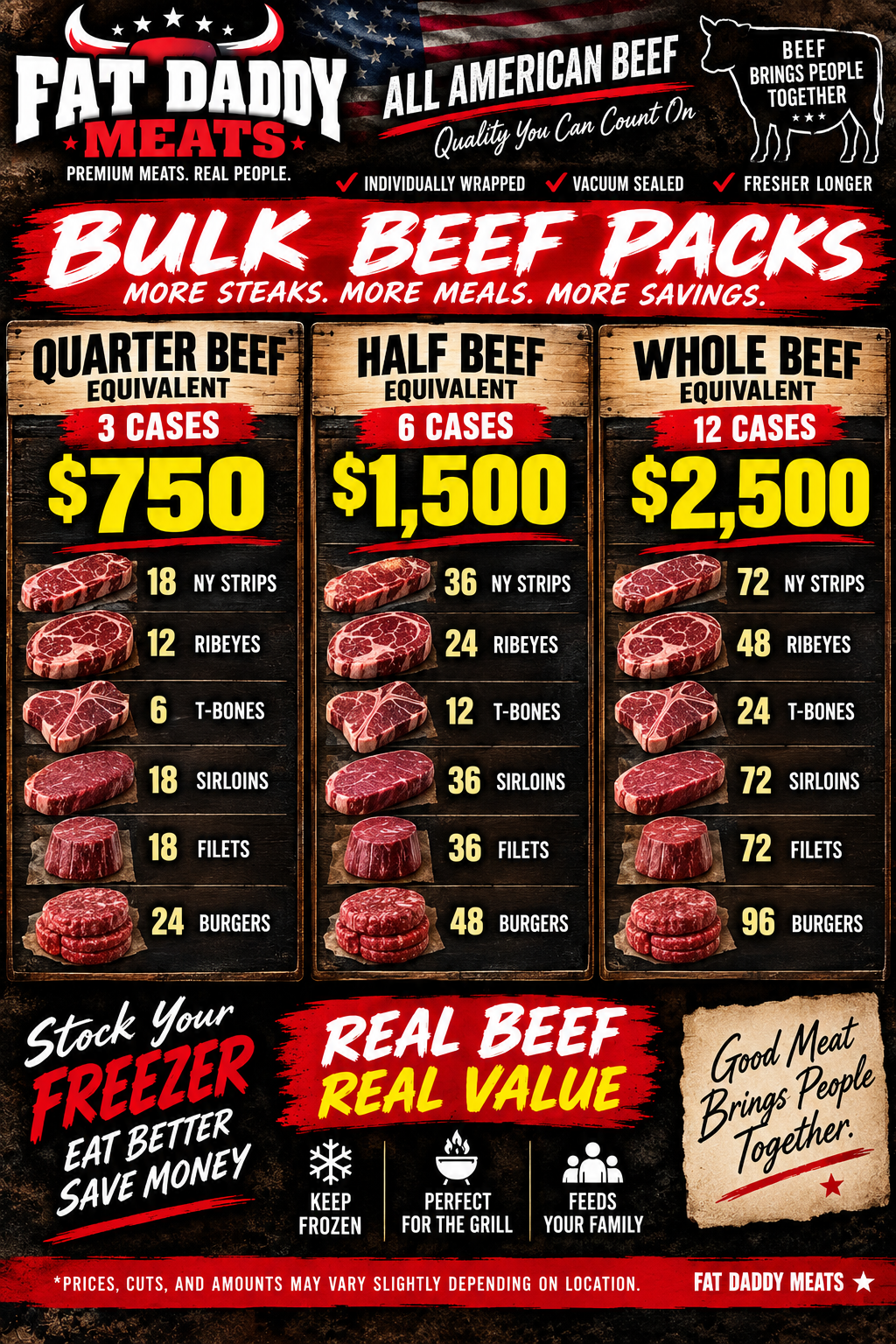
Our bulk packages focus much more heavily on the premium cuts people actually get excited about eating, including:
- Ribeyes
- New York strips
- T-bones
- Filets
- Sirloins
- Ground beef packs
You're not paying us to fill your freezer with organs, a pile of roasts and more ground beef than your family knows what to do with.
That was intentional.
After talking to customers and seeing what people actually eat, it became pretty obvious: give people more of the cuts they want.
Quantity AND Variety Matter
One thing people underestimate when they're comparing bulk beef to grocery-store shopping is the combination of quantity and variety.
Buying ten packages of whatever steak happens to be on sale isn't the same thing as opening your freezer and having several different steak options ready to go.
Maybe you want ribeyes Saturday night.
Filets for a special dinner.
T-bones on the grill.
Sirloins during the week.
Burgers another night.
You already have it.
That convenience becomes a bigger part of the value than people expect.
You Don't Have to Eat It Right Away
This is another major advantage.
Our beef is individually wrapped, vacuum sealed and frozen.
You aren't bringing home a huge amount of fresh meat and suddenly racing against the clock trying to eat it.
Take out what you need and leave the rest frozen.
The packaging also makes freezer storage easier than people expect. The packages are easy to stack, organize and squeeze into smaller spaces.
You don't necessarily need some enormous walk-in freezer just because you're buying beef in bulk.
Who Benefits Most From Buying Beef in Bulk?
From what I've seen, two groups really appreciate it: larger families and older customers.
Large families love the variety.
When you're feeding several people, having multiple options already in the freezer makes figuring out dinner considerably easier.
Older customers tend to really appreciate the convenience and security of having their freezer stocked.
They don't have to make another trip just because they want steaks for dinner.
It's already there.
But What About the Upfront Price?
This is probably the biggest mental hurdle for a first-time bulk buyer.
Don't compare the upfront bulk price to one grocery trip.
Compare it to what your family would spend buying the same types of beef over time.
Then consider the other costs:
How many trips to the store does it replace? How much fuel does that save? How much time? How many impulse purchases don't happen because you didn't walk through the store?
That's a much more realistic comparison.
If your family eats beef regularly anyway, you're not necessarily creating a new expense.
You're changing when and how you buy something you were already going to purchase.
Beef Prices Aren't Getting Any Easier to Predict
There's another reason I like stocking up.
Once the beef is in your freezer, you've locked in what you paid for it.
If retail steak prices increase next month, the ribeye sitting in your freezer doesn't suddenly cost you more.
For a family trying to control its grocery budget, there's real value in knowing you've already got a significant amount of your future meals purchased.
My Advice for First-Time Bulk Beef Buyers
Most of our customers haven't done this before.
So if that's you, you're normal.
My biggest advice is to look beyond the big chain markets and actually compare what you're getting for your money.
Don't just look at one advertised price per pound.
Look at the cuts.
Look at the variety.
Look at how it's packaged.
Think about how much of it your family will actually eat.
And compare it to what you'd spend buying those same premium cuts individually over time.
A cheap bulk purchase isn't a good deal if half of it consists of cuts your family doesn't want.
So, Is Buying Beef in Bulk Worth It?
For the right household, absolutely.
You're getting convenience, variety and a stocked freezer while potentially reducing the amount of time and money you spend making repeated trips to the store.
But I think what's actually in the package matters just as much as how much beef you're buying.
I'd rather see a family stock its freezer with ribeyes, strips, T-bones, filets, sirloins and ground beef they're excited to eat than save a few cents buying a freezer full of roasts they don't want.
So when somebody asks me whether buying beef in bulk is worth it, I still give them the same answer:
Only if you like saving money.